
'Clearly, from the Indian viewpoint, the US retrenchment from Asia cannot be happening as good news.' 'The abandonment of the US' pivot to Asia exposes the US-Indian partnership to be a mere transactional relationship,' says Ambassador M K Bhadrakumar

India's first indigenous nuclear-powered submarine is a considerable achievement -- and should have an impact on security strategy

'His secretary of defence nominee, General James Mattis, says he expects Pakistan to take action against terrorists operating from its soil.' 'Any pressure the US can bring on the Pakistani regime terror-wise would pay dividends for India.'

PM Modi seems to be gradually ending India's strategic ambiguity
Left parties on Wednesday warned the government that it would commit an "illegal act" if it tried to dilute the Civil Nuclear Liability Act or signed any agreement for supply of nuclear reactors during the upcoming United States visit of Prime Minister Manmohan Singh.

The report authored by Ashley Tellis, the top American expert on India and South Asia, states that the IAF's fighter force is weaker than numbers suggest.

The upcoming Indo-Pak National Security Adviser-level talks appeared to be on the verge of being aborted with both sides locked in a confrontation over Kashmiri separatist leaders.

A summary of sports events and persons who made news on Thursday

The deal would allow Japan to export nuclear technology to India.

Former external affairs minister, K Natwar Singh, shares his critique of the Narendra Modi government's foreign policy in this e-mailed interview with Aditi Phadnis. Edited excerpts

India can be called "more Islamic than Pakistan" as more Muslims live here than that country, Home Minister Rajnath Singh told the chief of Pakistan Rangers who called on him to discuss ways to keep the border peaceful.
He did not mention the issue of Jammu and Kashmir.

Vikas Swarup says India unlikely to give Pathankot-like offer to Pak in Uri attack probe.

Ramkumar Ramanathan recorded the second-biggest win of his career by shocking world number 98 Daniel Gimeno-Traver in the opening round of the ATP Chennai Open but there was no end to Somdev Devvarman's struggle as he was knocked out of the singles event, in Chennai on Tuesday.
The government has returned to talks with Pakistan, but can it withstand pressure from a jingoistic press and a rabidly nationalistic social media.

Given the relative rates of gross domestic product growth, the differential will increase.
'A three generation US-Pakistan relationship is not likely to be snapped any time soon. All this presents an irritant to an India that wishes to concentrate on economic development,' says Colonel Anil A Athale (retd).

Pakistani Foreign Office said they have come to the conclusion that the proposed NSA-level talks between the two countries would not serve any purpose, if conducted on the basis of the two conditions laid down by External Affairs Minister Sushma Swaraj.
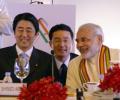
'Both nations have a common problem: A rampaging, jingoistic and hostile China which is making substantial territorial claims. In the long run, Japan and India are going to be the victims of Chinese aggression -- so they might as well hang together to contain China,' argues Rajeev Srinivasan.
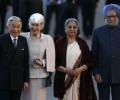
In recent years India-Japan relations have acquired rich economic content and strategic intents. Although the bilateral trade at $18 billion between the two countries is not very impressive and leaves much to be desired, the economic engagement between the two countries is both qualitatively and quantitatively noteworthy. India-Japan defence cooperation, however, has generated a lot interest among the strategic community in the context of rise of China. There has been a lot of speculation about India-Japan strategic partnership to hedge China, says Rup Narayan Das.

'There is no Buddha or Gandhi among countries, existing for the service of others; they all exist for the good of themselves.' 'For each country, its own interests should be paramount, and it is futile and churlish to expect China to be an exception to this rule,' says B S Raghavan, the distinguished civil servant and long-time China-watcher.
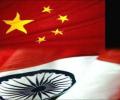
China wants a code of conduct for troops on the India-China border areas. While the Indian side has reacted cautiously, it is not clear what effective additional protocols that the current proposed code will bring forth to usher stability in the border areas, says Srikanth Kondapalli.

Nadal, who got a first-round bye, defeated Richard Gasquet 6-3, 6-4 to advance.
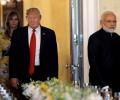
'China was the elephant in the Oval Office and Trump would have sensed that Modi's foreign policy architecture has become disoriented sans the US' pivot to Asia,' points out Ambassador M K Bhadrakumar.

Modi is practical person... If he comes in, he will revive the economy and create jobs, says Sanjay Suri.

It is time to forge a credible New Delhi-Srinagar axis, says Ajai Shukla.

New Delhi and Beijing are the only two regional capitals that have commented on US President Donald Trump's speech on August 21 outlining the way forward in Afghanistan. The Indian foreign ministry statement was effusive in praise, while the Chinese statement has been one of cautious and guarded hope. Delhi has identified itself with Trump's Afghan strategy, whereas the Chinese stance is calibrated -- observant and objective, keeping a distance, says Ambassador M K Bhadrakumar.

In the light of India's increasingly 'darkening' threat environment and the convergence of strategic interests between China and Pakistan, the IAF's declining combat capabilities are a cause for concern, says Brigadier Gurmeet Kanwal (retd).

'Chinese leaders rarely receive their foreign guests in cities other than Beijing. Such respect for India!' 'Does it mean that Modi could replicate "the warmth and unconventional way" by sending Indian troops into Tibet, as Xi did in Chumur (Ladakh) when he arrived in India? Of course, Indians are far too polite to do so,' says Claude Arpi.

'To consider BRICS anything more than a temporary club with some common interests would be folly. The goal should be to induce others (Japan, ASEAN, South Africa) to align with us -- a non-threatening, democratic nation, rather than with malevolent China or waning America. For us to consider aligning with either China or the US would be absurd. India is just too big to be a sidekick,' says Rajeev Srinivasan.
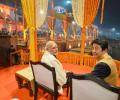
'Modi and Abe are working seriously for India-Japan bonhomie to grow stronger.' 'It is a win-win situation for both countries and the future look promising,' says Rajaram Panda, the Indian Council for Cultural Relations India Chair Visiting Professor at Reitaku University, Japan.
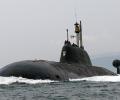
'We have been found seriously wanting in addressing our undersea warfare capability and China's emergence is a cause for concern.'

20 years ago this day, May 11, 1998, India conducted its second nuclear test at Pokharan in Rajasthan. In a fascinating interview on Rediff.com, K Subrahmanyam revealed how Indian PMs reacted to nuclear ambitions.

India, with its demonstrated capabilities of undertaking low cost high value inter-planetary travel, offers great opportunities for NASA to work with.

'Checkmating India by its nukes, Pakistan can pursue terrorism against India in the Kashmir Valley and also resume launching Mumbai 2008 style attacks.' 'The military oligarchy in Pakistan has a totally different view of what is desirable and possible in the subcontinent.'

When a Chinese warship entered Japanese waters, the Indian commander called on China to maintain discipline at sea. Dr Rajaram Panda explains the significance of the Malabar exercises between India, Japan and the US.

What is so honourable in defending or dis-honourable in not defending the 'Johnson line' in Aksai Chin? That is a question that needs to be asked to the Indian shouting brigade. The Chinese also need to be asked as to why they wish to implement the 'MacDonald McCartney' line drawn by British Imperialists? asks Col (retd) Anil Athale.
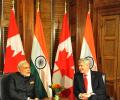
Canada will supply uranium to energy-starved India beginning this year over a period of five years, a decision which was termed as a launch of a new era of bilateral cooperation and mutual trust by Prime Minister Narendra Modi.

'India is a huge market for Chinese goods. I don't think a war stands to logic when you have economic compulsions, but then Chinese are known to do illogical things.'

With the United States delivering an increasing share of India's arms imports, New Delhi must work with it to retain control of our regional waters
 © 2026 Rediff.com - Advertise with us - Disclaimer - Privacy Policy - Sitemap - Feedback - About us - Terms of use - Grievances